Description
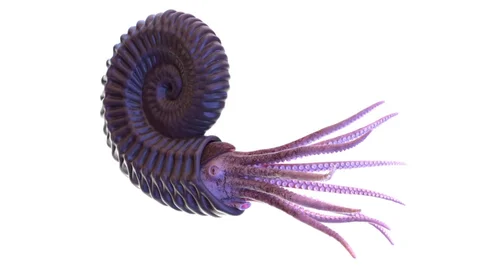
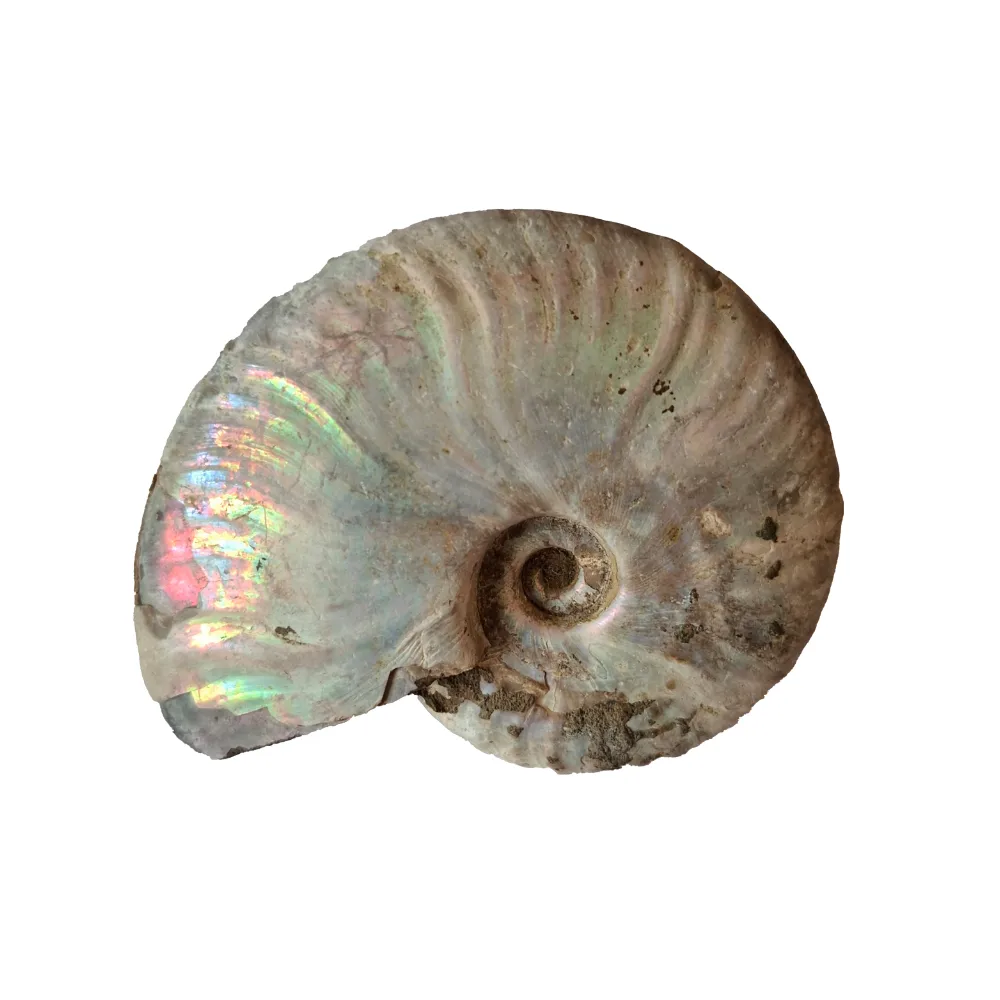
Ammonites were extinct marine cephalopods (class Cephalopoda), more precisely a group of the cephalopods. In appearance they resembled today's nautiluses, but they are more distant relatives in terms of classification. They got their name from their characteristic spiral-coiled shell, which in antiquity was compared to the ram's horn of the god Ammon.
They had an external, spirally coiled shell of lime divided into chambers. The cephalopod built the chambers as it grew and lived in the outermost chamber. The walls separating the chambers (septa) were joined to the outer shell by complex suture lines, which make it easy to tell species apart. Their size ranged from a few centimetres up to 2 metres in diameter.
Importance in Earth history
They appeared in the Devonian period (~400 million years ago). They died out at the end of the Cretaceous, together with the dinosaurs, about 66 million years ago. Thanks to their fast evolution and wide distribution, ammonites are also excellent index fossils, especially for dating Mesozoic layers (Triassic, Jurassic, Cretaceous).
Occurrence
Their fossils can be found worldwide in sedimentary rocks. Famous localities: England (Jurassic Coast), Germany (Solnhofen), France, Morocco, Russia. In Hungary, ammonites have also been found in the Bakony, Gerecse and Mecsek hills, in Triassic and Jurassic rocks.